


How to Market Your Health Coaching Practice Successfully

More marketing activity won’t necessarily bring you more health coaching clients. Focused goals and consistent, relevant communication can. Effective marketing for health coaches starts with a clear audience and an offer shaped around the problems they want to solve. Build trust with useful content, then make it easy for interested readers to take the next step.
If it’s hard to turn your knowledge into a steady flow of enquiries, a clearer plan can help. Define a marketing goal, choose channels that suit your audience and create evergreen blog content that can attract potential clients over time. You can also build relationships and give readers a straightforward way to learn more about your coaching.
Start with a focused offer and a realistic marketing routine instead of trying to post everywhere. Then track what’s working and make considered adjustments as your practice develops.
Table of Contents
1. Business tools for websites, email marketing and client management
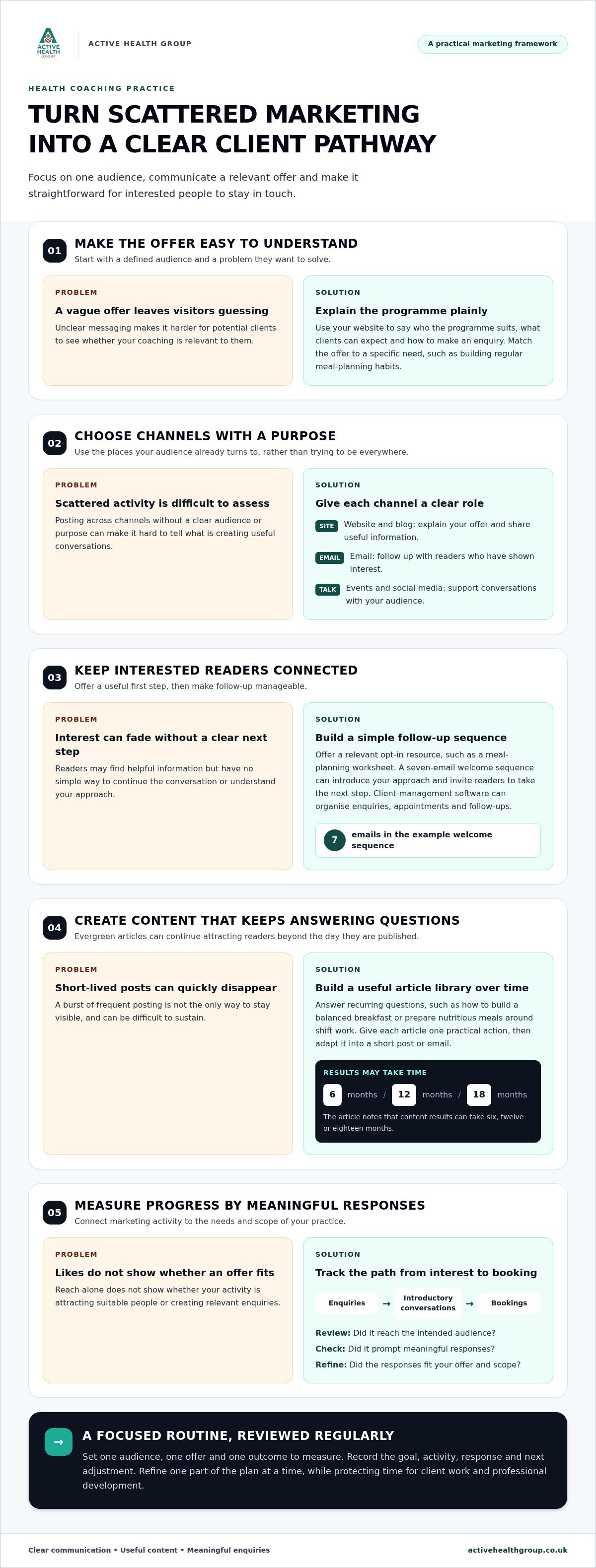
Build your coaching business around one audience and a problem they want to solve. Your website should explain your programme, who it suits, what clients can expect and how to enquire. Offer a useful opt-in resource, such as a meal-planning worksheet, and use an email platform to send a welcome sequence. A seven-email sequence can introduce your approach and invite readers to take the next step. Client-management software can help you organise enquiries, appointments and follow-ups.
Which marketing channels work best for health coaches, and how do their costs and results compare? Choose channels your audience uses. A website and blog take consistent time; paid advertising requires a set budget. Email helps you follow up with interested readers, while events and social media can support conversations. Compare the quality of enquiries and how they progress, not just how many people you reach.
Match your offer to a specific need, such as building regular meal-planning habits. A short group programme can introduce your coaching before private support. Christina Russell enrolled eight clients in a short group programme, then three participants in private coaching. Keep the programme manageable, with clear sessions and an achievable focus, so clients aren’t overwhelmed. If someone feels resistance, ask what seems difficult and agree on one small action.
What UK rules apply to health coach advertising, testimonials and health claims? Keep promotions accurate, support health claims with evidence, and use genuine testimonials with permission. Ethical marketing avoids promises of cures or guaranteed outcomes. Explain the scope of your coaching clearly and distinguish it from medical care.
What should a health coach include on a website to attract and convert clients? Use clear branding, a focused offer, an explanation of your approach, relevant credentials, genuine testimonials and one straightforward enquiry route. Tell visitors what happens after they get in touch.
To find your first clients, define your audience, ask about their needs at events or online, then test one offer and one channel. Common pitfalls include vague messaging, scattered marketing, unsupported claims and launching too many programmes. Review enquiries regularly and adjust one element at a time.
2. Evergreen blog content as a marketing strategy
Evergreen blog articles answer questions your audience will keep asking, such as how to build a balanced breakfast or prepare nutritious meals around shift work. Unlike a short-lived social post, a useful article can continue attracting readers through search and sharing. Amy Lippmann describes twelve strategic blog posts as a way to attract clients for years. Choose topics that match your coaching focus, and give each article one practical action readers can try.
What are the most effective marketing strategies for health coaches in the UK? Pair useful website articles with consistent sharing through a channel your audience uses, such as a newsletter or social platform. For example, a wellness coach focused on nutrition could explain meal-planning basics, then share the article with readers interested in making a specific change.
Consistency matters more than posting every day. Set a sustainable schedule, such as publishing a well-researched article regularly, and adapt each piece into a short post or email. Content can build an audience over time, though results may take six, twelve or eighteen months. Balance helpful education with a clear explanation of how coaching supports clients.
Started with a blank page? Use AI to brainstorm common questions in your niche and organise them into an editorial plan, comparing suggestions with relevant health coaching resources. For example, prompt it to suggest article ideas for people who want to improve their meal-planning routine. Check every outline for accuracy, add your professional perspective and keep claims within your scope. Explain exactly what coaching involves, including the client’s role in choosing and taking action.
3. Health coach marketing goals
A successful health coaching business needs goals that connect marketing activity to the needs of the practice. Choose one target audience, one offer and one outcome to measure. For example, aim to increase suitable enquiries for a course on building healthier routines. Track enquiries, introductory conversations and bookings instead of treating social media likes as proof of demand. Review progress regularly and adjust one part of the plan at a time.
Make each goal specific enough to guide your next action. If your practice supports people changing their eating habits, create an Instagram post that answers a common question, then direct interested readers to a relevant article or enquiry form. Record which channel led to each conversation. This helps you decide whether Instagram, a newsletter or an event deserves more attention.
Choose measures that reflect the work you want to do. A coach supporting weight loss could track enquiries about behaviour change while avoiding promises of a particular result. A coach planning in-person sessions might build relationships with a community running group and note how many conversations lead to follow-up. These examples connect goals to real audiences, not abstract reach.
Set a review point and ask three questions: Did the activity reach the intended audience? Did it prompt meaningful responses? Did those responses fit your offer and scope? If not, refine your message before adding another channel. Keep a simple record of the goal, action, response and next adjustment. This turns marketing for health coaches from scattered activity into a practical process, while protecting time for client work and ongoing professional development.
Active Health Group: Level 5 Advanced Diploma in Integrative Health and Nutrition Coaching
Active Health Group offers the Level 5 Advanced Diploma in Integrative Health and Nutrition Coaching for those developing professional coaching and nutrition knowledge. It may suit you if you want your practice to bring behaviour change skills together with a stronger understanding of nutrition, while maintaining clear professional boundaries.
Your next step depends on your current focus. The Level 6 Diploma in Health Coaching and Clinical Nutrition combines coaching with clinical nutrition, while the Level 6 Diploma in Clinical Nutrition focuses on nutrition. For a specialist topic, the Level 5 Certificate in Gut Microbiome and Nutrition offers a more focused area of study.
Consider which knowledge would strengthen your work with clients, then review the course details to see how each option fits your development plans. For further information, contact Active Health Group or visit activehealthgroup.co.uk.
Choose your next deliberate step
A coaching practice develops through consistent choices, not by trying every channel at once. Set one priority for the coming weeks: clarify your audience, strengthen your professional knowledge or create a manageable content routine. Decide what action will move that priority forward and when you’ll review it.
Marketing for health coaches works best when it reflects the quality and boundaries of the support they provide. As your practice grows, keep building the skills to communicate clearly, work ethically and support sustainable behaviour change. Further study can deepen your knowledge and help you shape the services you’re ready to offer.
If you’d like to explore training that supports your development in health coaching and nutrition, contact Active Health Group today. Take the next step at a pace that fits your professional aims, and keep building a practice grounded in purposeful, person-centred work.
Frequently Asked Questions
Want to bring in more health coaching clients?
Make the first step clear and straightforward for someone considering your support. Explain who your service suits, what an initial conversation covers and how to arrange one. After the conversation, follow up with a concise summary of the person’s stated priorities and the next step you agreed. This keeps communication relevant and helps both parties decide whether the fit is right.
How can a health coach define a niche and ideal client?
Review your experience and training, then identify the needs you can support within your competence. Write a short description of the clients you want to work with and the boundaries of your service. For example, you could specify that you support adults developing everyday wellbeing habits, rather than suggesting you diagnose or treat medical conditions. Revisit the description as your practice develops.
How can health coaches market their services on social media and build an email list?
Keep professional content distinct from personal posts, and make your profile explain your role and scope. Respond courteously to comments or direct messages without turning a public exchange into personal health guidance. For email, invite people to subscribe voluntarily and explain what updates they’ll receive. Respect their preferences and remove anyone who asks not to receive further messages.
How much do health coaching websites, advertising and marketing tools cost in the UK?
Choose tools according to the tasks your practice needs to manage. A basic website may need clear service information, an enquiry form and a way to publish articles; additional tools can support appointments, email or record-keeping. Before choosing platforms, list essential functions and decide which tasks can be managed in one place. This makes comparisons more relevant to your actual workflow.
How can UK health coaches use SEO and local search to find clients?
Build pages around the questions and services your intended audience is likely to search for. Use clear page titles and headings, describe your coaching approach accurately, and keep your contact details consistent wherever your practice appears. An article answering a specific search, such as coaching support for healthier routines, can help readers assess whether your service meets their needs.


Comments