


Behaviour Change and Coaching Through Goals and Action Plans

A goal matters when it can be put into practice. Behaviour change and coaching connect a person’s priorities with practical actions, then use reflection and support to help make those actions sustainable. The process works best when goals suit the individual’s circumstances and progress is reviewed to identify what helps and what gets in the way.
You may already know lasting change takes more than good intentions. The challenge is turning that understanding into a clear, person-centred plan while recognising when a client needs support beyond coaching. This article explains how collaborative goal-setting, action plans and leadership can support behaviour change, and how health and wellness coach training develops the skills to apply these approaches responsibly. It also explores how coaching practice moves from understanding change to helping people navigate real-world decisions and setbacks.
Table of Contents
Collaborative goal-setting and personalised action plans
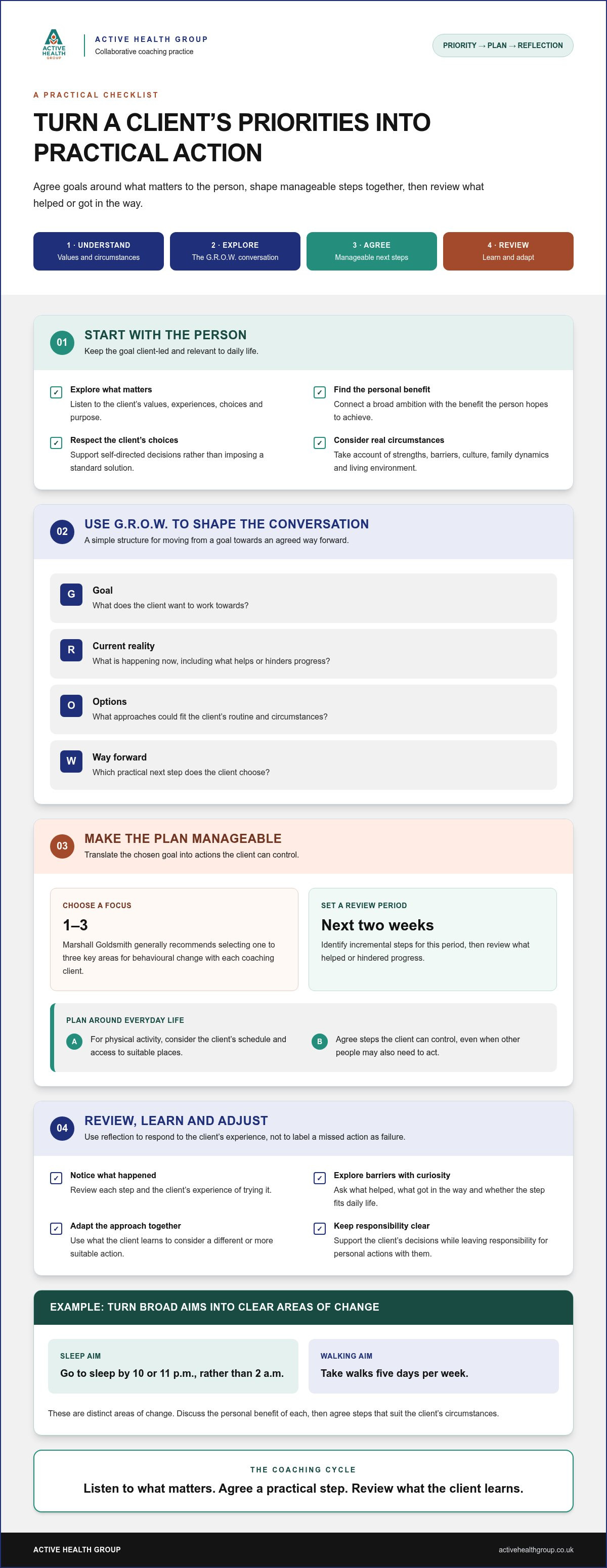
Coaching turns a client’s priorities into agreed goals and practical next steps. The G.R.O.W. model can structure conversations around goals, current reality, options and the way forward.
Person-centred coaching
Person-centred coaching begins with the client’s values, experiences and choices, rather than imposing a standard solution. A goal is more meaningful when it connects with the person’s purpose and the benefit they hope to achieve. By listening with empathy and showing respect, a coach helps the client determine what matters to them. These skills support self-directed decisions while leaving responsibility for personal actions with the client.
Personalised action plans
A personalised action plan turns a client’s chosen goal into manageable steps that fit daily life. The coach and client consider strengths, barriers, culture, family dynamics and living environment. For example, a physical activity plan should reflect someone’s schedule and access to suitable places, rather than assume everyone has the same options. Reviewing each step helps coaches and leaders adapt their support to the person’s experience.
Purpose helps connect a broad ambition to a specific behaviour. In a coaching example, a patient’s long-term aims included going to sleep by 10 or 11 p.m., rather than 2 a.m., and taking walks five days per week. Those aims reflect distinct areas of change, so the coach and patient can discuss the personal benefit of each.
Accountability focuses on actions the client can control, even when other people may also need to act. Marshall Goldsmith generally recommends selecting 1-3 key areas for behavioural change with each coaching client. From there, coach and client can identify incremental steps for the next two weeks, review what helped or hindered progress, and adjust the plan. This makes progress easier to assess without treating a missed action as failure.
How can coaches and leaders facilitate behavioural change?
Coaches and leaders can help people put new behaviours into practice through focused support and reflection. The approach should match the person’s readiness and the change they want to make.
Supporting healthier, more active habits
Health coaches can support changes to eating patterns, physical activity, sleep, stress management and social connection. The client chooses an area that matters to them, while the coach helps identify a manageable action. For example, someone hoping to move more might explore what gets in the way of walking, then choose an activity that suits their routine and current ability.
Feedforward and supportive feedback
Feedforward focuses on constructive actions a person can take next. Supportive feedback helps them learn from experience without treating a setback as a personal failing. Marshall Goldsmith recommends a mini-survey with key stakeholders within six months of starting an executive coaching process. Their observations can help leaders assess whether colleagues notice the intended behavior change.
Taking action to support change
Coaches help clients put achievable actions into practice and review what they learn. If someone keeps postponing a planned activity, the coach can explore whether confidence, timing or competing demands are influencing the pattern. Together, they can consider a different approach, treating action as part of learning rather than waiting for motivation to appear first.
When additional professional support may be needed
Coaching may need to sit alongside other professional support when a person’s needs fall outside the coach’s competence. Coaching generally focuses on goals and future action; counselling may explore emotional difficulties, mentoring shares experience, and therapy addresses needs within its professional scope. There is no single UK-wide coaching package: the coach and client agree the format and scope. Evidence indicates coaching can support behavior change, with outcomes shaped by readiness, approach and context.
Training and certification for health and wellness coaches
Training helps turn an interest in behaviour change into focused, responsible coaching practice. A relevant course should develop listening, goal-setting and behavior-change skills alongside knowledge of health, ethics and professional boundaries. These foundations help practitioners support sustainable change without treating coaching as a substitute for clinical care.
To find a qualified behaviour change coach in the UK, ask about their health-coaching qualification, practical experience and approach to continuing professional development. Discuss your goals and clarify how the coach works, including when they would recommend support from another professional.
For a career in health coaching, look for learning that connects theory with realistic practice. For example, a session might explore a client’s readiness, agree on a small action and review what happened next. Training should help learners distinguish coaching from advice-giving, adapt their approach to each person and recognise when a client’s needs are outside their competence.
In the UK, compare a course’s level, assessment and awarding organisation with your intended career path. These details show what learning is assessed and what the resulting qualification represents. Professional-body recognition is a separate consideration, so consider its relevance to your intended practice and any membership criteria.
When comparing courses, consider whether assessment tests applied skills as well as knowledge. Look for opportunities to practise coaching conversations, receive feedback and reflect on professional boundaries. These steps connect study with real client work, from agreeing an appropriate focus to recognising when additional expertise is needed.
Active Health Group: Level 5 Advanced Diploma in Integrative Health and Nutrition Coaching
Active Health Group’s Level 5 Advanced Diploma in Integrative Health and Nutrition Coaching offers a structured next step if you want to develop coaching practice alongside nutrition knowledge. It may suit aspiring practitioners and existing health professionals seeking to support clients with lifestyle and nutrition goals within clear professional boundaries.
If you want to focus more specifically on coaching, the Level 5 Certificate in Coaching for Health and Wellbeing provides another relevant route. For further specialisation, options include the Level 6 Diploma in Clinical Nutrition, the Level 6 Diploma in Health Coaching and Clinical Nutrition, and the Level 5 Certificate in Gut Microbiome and Nutrition.
Consider which knowledge and skills best match your intended role before choosing a course. You can explore the Level 5 health coaching course or contact Active Health Group to discuss your next step.
Put your learning into practice
As you plan your next professional step, consider whether you want to deepen your coaching practice, develop clinical nutrition knowledge, or combine both areas. Active Health Group offers the Level 5 Advanced Diploma in Integrative Health and Nutrition Coaching, the Level 6 Diploma in Clinical Nutrition and the Level 6 Diploma in Health Coaching and Clinical Nutrition.
Behaviour change and coaching require ongoing reflection, sound boundaries and a commitment to learning. Choose a pathway that supports the work you intend to do and the skills you want to develop.
Contact Active Health Group to learn more, and take your next step in professional development.
Frequently Asked Questions
Why Study This Behavioural Change Course?
Study behavioural change to develop skills for supporting people with health and lifestyle goals. Structured learning can help you practise attentive listening, agree realistic actions and recognise professional boundaries. For example, a coach may learn to distinguish a client’s own priorities from goals imposed by others. These skills can support career development in health coaching, nutrition and related wellbeing practice.
What is a typical length of a coaching programme?
There is no single typical programme length. It depends on the client’s aims, the focus of coaching and how often sessions take place. A short, defined goal may call for a different schedule than broader personal development. UK Coaching advises leaving up to two weeks between sessions so learners can practise what they have learned. Regular reviews help determine whether the pace remains useful.
What is behaviour change coaching and how does it work?
Behaviour change and coaching combine supportive conversation with practical steps towards a behaviour a person wants to change. The coach helps the client explore what is getting in the way, identify a useful next action and reflect on its effects. For instance, someone struggling with regular meal planning might look at time constraints before choosing an approach that fits their routine.
What are the main behaviour change coaching techniques and models?
Useful approaches include the G.R.O.W. model, solution-focused coaching and force-field analysis. G.R.O.W. organises a conversation around a goal and possible actions. Solution-focused questions draw attention to workable options, while force-field analysis examines factors that help or hinder change. A coach selects techniques according to the client’s priorities, readiness and the purpose of the session.
How do you set effective behaviour change goals and track progress?
Choose a measure that reflects the behaviour itself, rather than relying only on a broad outcome such as feeling healthier. Someone working on sleep, for example, could record their bedtime consistently and note whether they followed their chosen routine. A simple measure makes patterns easier to spot and gives the client and coach a clearer basis for discussing what the information means.


Comments